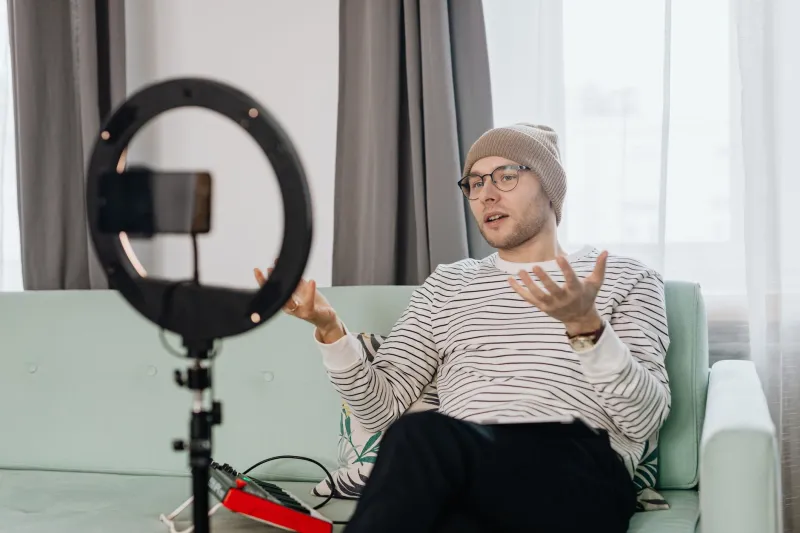
Why Americans Are Ditching Reruns for the Unscripted, Unfiltered Rush of Live
Photo: BLMUtah, Public domain, via Wikimedia Commons
The Moment Nobody Could Rewind
During a live-streamed indie concert last spring, the artist's guitar string snapped mid-song. She stopped, laughed, swore under her breath, and spent three minutes restringing on camera while 18,000 people watched from their living rooms, cars, and apartment kitchens across the country. The chat exploded. Clips spread across social media within minutes. Fans who weren't even watching tuned in to see what the fuss was about.
Nobody would have clipped that moment from a studio album. Nobody would have shared it from a pre-recorded music video. But live? That imperfect, unplanned, entirely human moment became the most-talked-about thing she'd done in years.
That's the power of live — and in 2024, American audiences are chasing that feeling harder than ever.
Opinion: Edited Is Safe. Live Is Real.
Let's call it what it is. The entertainment industry spent decades perfecting the art of making everything look flawless — tight edits, color correction, reshoots, focus groups, network notes. And for a long time, audiences accepted that this was just how entertainment worked.
But something cracked open during the pandemic years. When traditional production ground to a halt and creators, musicians, comedians, and talk show hosts started going live from their homes with zero infrastructure, audiences didn't recoil. They leaned in. Hard.
What viewers discovered — and what they haven't forgotten — is that the mess, the spontaneity, the genuine reactions, and the feeling of being there as something unfolds are not bugs. They are the feature. Edited content is safe. Live content is real. And real, it turns out, is what people actually want.
This isn't just a vibe shift. It's a structural change in how entertainment is being consumed, produced, and valued.
The Geography Problem That Live Events Just Solved
For most of American entertainment history, access has been deeply unequal. If you lived in New York, Los Angeles, or Chicago, you could see almost any artist, comedian, or performer you wanted. If you lived in rural Montana, a small town in Mississippi, or anywhere without a major venue within reasonable driving distance, your options were dramatically limited.
Live digital events have quietly dismantled that barrier in a way that nothing before them managed to do.
"I'm in a town of about 8,000 people in central Kansas," says Rebekah, 34, a regular attendee of live-streamed comedy and talk events. "Before any of this, the closest anything like a real show came to me was a three-hour drive to Kansas City. Now I watch live stuff three or four nights a week from my couch. I interact with the hosts. I feel like I'm actually there." She pauses. "Honestly, sometimes the live stream community feels more like my people than the folks in my actual town."
That sentiment — finding genuine community through real-time shared experience — keeps surfacing in conversations with live event audiences. The geographic democratization is real and measurable, but the emotional democratization might be even more significant.
Event Organizers Are Rewriting the Rulebook
The people building live digital events aren't just transplanting traditional formats onto a screen. The most successful ones are creating entirely new kinds of experiences that couldn't exist in any other medium.
Take interactive talk formats, where audience members vote in real time on topics, submit questions that actually get answered, and influence the direction of the conversation as it happens. Or crowdsourced performance events, where the audience collectively decides setlists, challenges, or creative decisions mid-show.
"The audience isn't passive anymore," says Derek, who organizes live-streamed music events for independent artists across the Southeast. "They're participants. When you give people actual agency in what they're watching, the investment they feel is completely different. They're not watching a show — they're part of building it."
That participatory element changes the emotional math of entertainment entirely. When you helped decide what happened, you have a stake in what unfolds. You're not a consumer. You're a co-creator.
What Legacy Media Is Getting Wrong
Here's the uncomfortable truth that traditional entertainment institutions are slowly being forced to reckon with: the things they've always considered their greatest strengths — production value, established talent, polished presentation — are becoming less relevant to the audiences they're trying to retain.
Major networks and studios are still pouring enormous resources into making content look expensive. Meanwhile, a live stream with a creator who genuinely connects with their audience is pulling comparable — and sometimes larger — engagement numbers at a fraction of the cost.
The legacy model assumed that audiences wanted to watch something that looked important. What audiences actually wanted, apparently, was to feel something that mattered to them personally.
This doesn't mean traditional media is finished. But it does mean that any entertainment institution that isn't actively building real-time, interactive components into its strategy is operating on borrowed time. The audiences who grow up expecting to participate in their entertainment won't patiently sit through content that treats them as spectators.
The Feeling That Algorithms Can't Manufacture
Ask anyone who regularly attends live digital events what keeps them coming back, and they'll use some version of the same language: it felt like something real.
That feeling is not accidental, and it's not just nostalgia for the pre-streaming era. It's a specific psychological response to shared, synchronous experience. When thousands of people are watching the same unscripted moment at the same time — reacting, commenting, laughing, gasping together — something neurological happens that simply doesn't occur when you watch a perfectly edited video alone on your couch on a Tuesday.
You feel connected. To the creator, yes, but also to the thousands of strangers experiencing the same thing at the same moment. That's a fundamentally different kind of entertainment — and it's one that no algorithm, no matter how sophisticated, can manufacture from recorded content.
"There's a chat moment I think about all the time," says Yolanda, 29, a live event enthusiast from Atlanta. "The host said something unexpected and the entire chat just flooded with the same reaction at once. Thousands of people, all saying the same thing at the same second. I felt like I was in a stadium. I was sitting in my kitchen in Atlanta, but I was absolutely in a stadium."
This Is Not a Phase
The numbers support what audiences are already feeling. Live streaming viewership in the United States has grown consistently year over year, with interactive formats showing the steepest gains. Younger demographics — the audiences that advertisers and entertainment executives spend the most time worrying about — are the most enthusiastic adopters.
But the numbers are almost beside the point. What matters is the shift in expectation. A generation of American entertainment consumers is growing up understanding that they don't have to watch passively, that they don't have to accept whatever gatekeepers decide to broadcast, and that the most meaningful entertainment experiences they've ever had happened in real time, unfiltered and unscripted.
That expectation doesn't reverse. It compounds.
Live isn't replacing traditional entertainment because it's cheaper or more convenient — though it often is both. It's replacing it because it offers something that edited, polished, pre-packaged content structurally cannot: the genuine, irreplaceable feeling of being present when something real happens.
In a media landscape crowded with content designed to look important, live is the thing that actually feels important.
And once you've felt the difference, going back is a whole lot harder than it sounds.